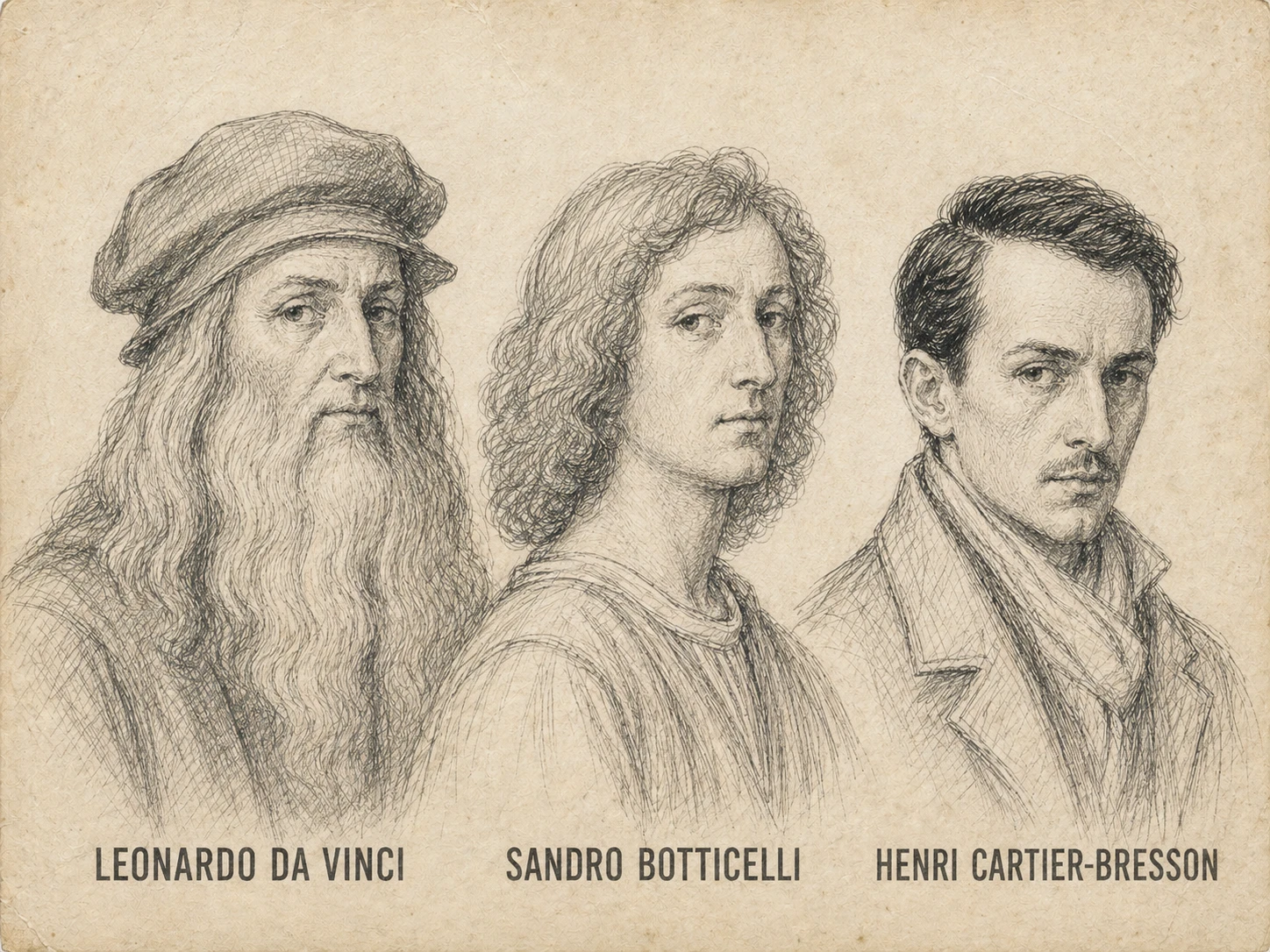
Three things happened in art history that almost nobody tells you about:
- In 1509, Leonardo da Vinci illustrated a math textbook.
- In 1485, Botticelli painted a goddess on a canvas that is the wrong size on purpose.
- In 1932, a 24-year-old Frenchman raised a small German camera to his eye and then refused, for the next seventy years, to explain why his photographs worked.
These three events are the same event. And once you see the thread connecting them, you cannot unsee it — which is, of course, why nobody mentions it.
Let me walk you through the conspiracy.
Act I: Leonardo Illustrates a Math Book (Milan, 1509)
Picture Milan at the turn of the sixteenth century. The plague has come and gone three times in the last decade. Columbus returned from the Americas seventeen years ago and is still insisting, against mounting evidence, that he found India. Michelangelo is 34 and has just finished the David. And Leonardo da Vinci — 57 years old, famously incapable of finishing anything on time — is between gigs.
Into this scene walks a Franciscan friar named Luca Pacioli. Pacioli is a mathematician with a book to publish, a beautiful one, about a number: the ratio 1.618, which he calls the Divine Proportion. The book needs illustrations. Pacioli needs an artist. Leonardo needs a side hustle.
The book is De Divina Proportione. Leonardo draws sixty geometric solids for it. Sixty. He does this while also reworking The Last Supper, which — small coincidence — is composed using the very ratios Pacioli is writing about.
This is the moment. This is when "the Golden Ratio" stops being an inside joke among mathematicians and becomes a public artistic principle. And Leonardo, ever the opportunist, applies it everywhere. The Vitruvian Man. The Mona Lisa. The Annunciation. Salvator Mundi. Whether he was consciously plotting each placement on a grid or had simply absorbed the math so deeply that his eye now thought in ratios — art historians still argue about this in print, at conferences, and presumably at dinner parties no one wants to attend. The argument doesn't really matter. The result is the same: his paintings feel right in a way nobody before him had quite cracked.
Leonardo died in 1519, possibly in the arms of the King of France, definitely surrounded by hundreds of unfinished projects and thousands of notebook pages written in mirror script. He left behind a single mathematical idea that would not stop spreading. It is, in fact, still spreading. It is in your iPhone right now, whether you know it or not.
Act II: Botticelli's Off-By-Four-Thousandths Canvas (Florence, 1485)
Now back up twenty-four years to Florence, where Sandro Botticelli is painting The Birth of Venus.
Here is a fun fact that, once you know it, you will think about more often than is probably healthy: the canvas is approximately 172.5 cm by 278.9 cm. Run the numbers, and the ratio is 1.614.
The Golden Ratio is 1.618.
Botticelli's canvas is off by four one-thousandths.
Either he was a hair short on linen, or he was doing something deliberate. Given that Venus's navel sits almost exactly on the canvas's golden section, and her shoulder line aligns with another golden division, and the wind god Zephyr's body crosses the frame on a third — I'm going to go with deliberate.
But here is the awkward part of the story: Botticelli is painting Venus in 1485, which is twenty-four years before Pacioli publishes the book. So how does he know the ratio?
He doesn't, exactly. Or rather, he knows it the way artists in every era know it: by inheritance and by eye. The Greeks built the Parthenon with these proportions. The Egyptians embedded them in pyramids. Painters in fifteenth-century Italy grew up surrounded by buildings, sculptures, and altarpieces all unconsciously echoing the same math. Botticelli wasn't reading equations. He was breathing them in with the Florentine air.
Then his career fell off a cliff. Around 1494, a charismatic preacher named Savonarola convinced half of Florence to burn its luxuries in a public bonfire — including, allegedly, some of Botticelli's own paintings, which Botticelli reportedly tossed in voluntarily. (The lesson here, for any artists reading: do not throw your own work in a bonfire because a man in a robe told you to.) Botticelli died in 1510, broke and largely forgotten, his style considered hopelessly out of fashion. The Birth of Venus spent the next four hundred years quietly being a masterpiece while almost nobody looked at it. It would take until the nineteenth century for someone to rediscover Botticelli, and another fifty years after that for someone to measure his canvas with a ruler and notice the conspiracy.
Act III: A Frenchman With a Leica (Paris, 1932)
Skip ahead 422 years.
It is 1932. The Great Depression is two years old. Hitler will become Chancellor of Germany in three months. A young Frenchman named Henri Cartier-Bresson is 24, recently returned from a year of hunting big game in the Ivory Coast (he gave it up after nearly dying of a fever, which seems, frankly, like a reasonable career pivot), and he has just bought a Leica.
The Leica is small. This matters. Until this point, cameras have basically been tripod-mounted suitcases. The Leica fits in your hand. You can walk down a street and raise it to your eye in one motion. For a photographer, this is the difference between writing a poem and improvising a song.
But here is the thing about Cartier-Bresson: before he was a photographer, he was a painter. He had spent his teenage years studying under André Lhote, a Cubist who was obsessed with — wait for it — the Golden Ratio. Lhote drilled his students in the geometry of the Renaissance masters. He made them stare at Leonardo and Botticelli and figure out the diagonals. Cartier-Bresson read Matila Ghyka's The Geometry of Art and Life, the 1920s bible of compositional mathematics, and never got it out of his head.
So when this young man raises his Leica on a Paris street, he is not seeing the world the way you and I see it. He is seeing it as a chessboard of diagonals and intersections, of Phi grids and harmonic armatures. When a man leaps over a puddle behind the Gare Saint-Lazare in 1932, Cartier-Bresson presses the shutter at the exact fraction of a second when the man, his reflection, and the curve of the puddle align with the geometry he learned in Lhote's atelier.
He calls this "the decisive moment." The world calls him a genius. He goes on to co-found Magnum Photos, document the funeral of Gandhi, photograph Coco Chanel and Albert Camus and the Spanish Civil War, and live until 2004, dying at 95 with a bibliography longer than most people's lifetimes.
When Cartier-Bresson was asked, late in life, what made a good photograph, he answered with a single word: "Geometry."
So far, so good. The Renaissance flows directly into modern photography. Three masters, one principle, five centuries of continuity.
Now here is where it gets a little awkward for us.
The Awkward Part: Cartier-Bresson Hated Grids
The same Henri Cartier-Bresson who built his entire visual language out of golden ratios, harmonic armatures, and dynamic symmetry once wrote:
"I hope we will never see the day when photo shops sell little schema grills to clamp onto our viewfinders; and the Golden Rule will never be found etched on our ground glass."
He said this. Out loud. In print. In a book.
And here at Artistic Composition, we are very politely about to disagree with the great man.
Because here is the thing Cartier-Bresson conveniently left out of that quote: he had spent ten years studying painting before he ever picked up a camera. Ten years of André Lhote standing behind him, pointing at canvases, drawing diagonals over Botticelli with a piece of chalk. By the time Cartier-Bresson lifted a Leica, the grid was already inside his retinas. He didn't need it on his viewfinder because it was etched on his eyeball.
Most of us did not get to apprentice with a French Cubist for a decade. Most of us are walking around with iPhones, encountering a beautiful sunset, and thinking "that looks pretty" without the foggiest idea why. We do not have the geometry pre-installed.
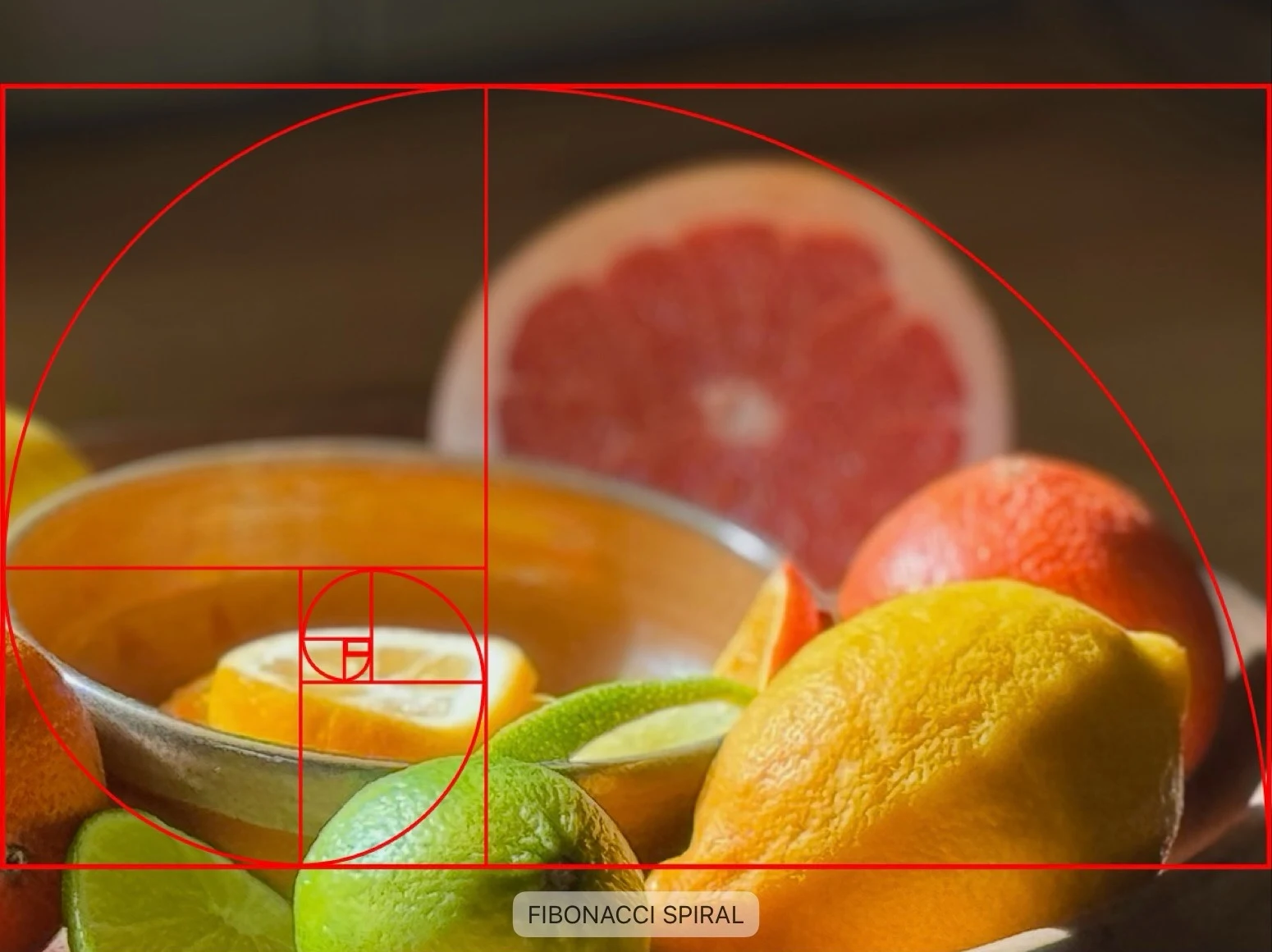
This is what the Wise Camera app is for. It puts the grid on your viewfinder temporarily — not as a crutch, but as a tutor. After a few weeks of shooting with the Phi Grid overlay, the Phi Grid starts appearing in your eye whether the app is on or off. After a few weeks of framing things with the Fibonacci Spiral, you start seeing it in seashells and staircases and the curl of someone's hair without prompting. The grid does not become a permanent prosthetic; it becomes a teacher you eventually outgrow.
Which is, ironically, exactly how Cartier-Bresson learned. He just had a French painter doing the work that an iPhone app does today.
The 15 Compositions, Then and Now
What Pacioli wrote down, what Leonardo illustrated, what Botticelli painted by feel, and what Cartier-Bresson refined into a photographic doctrine — all of it survives today as a set of fifteen artistic compositions that any photographer, painter, or designer can learn.
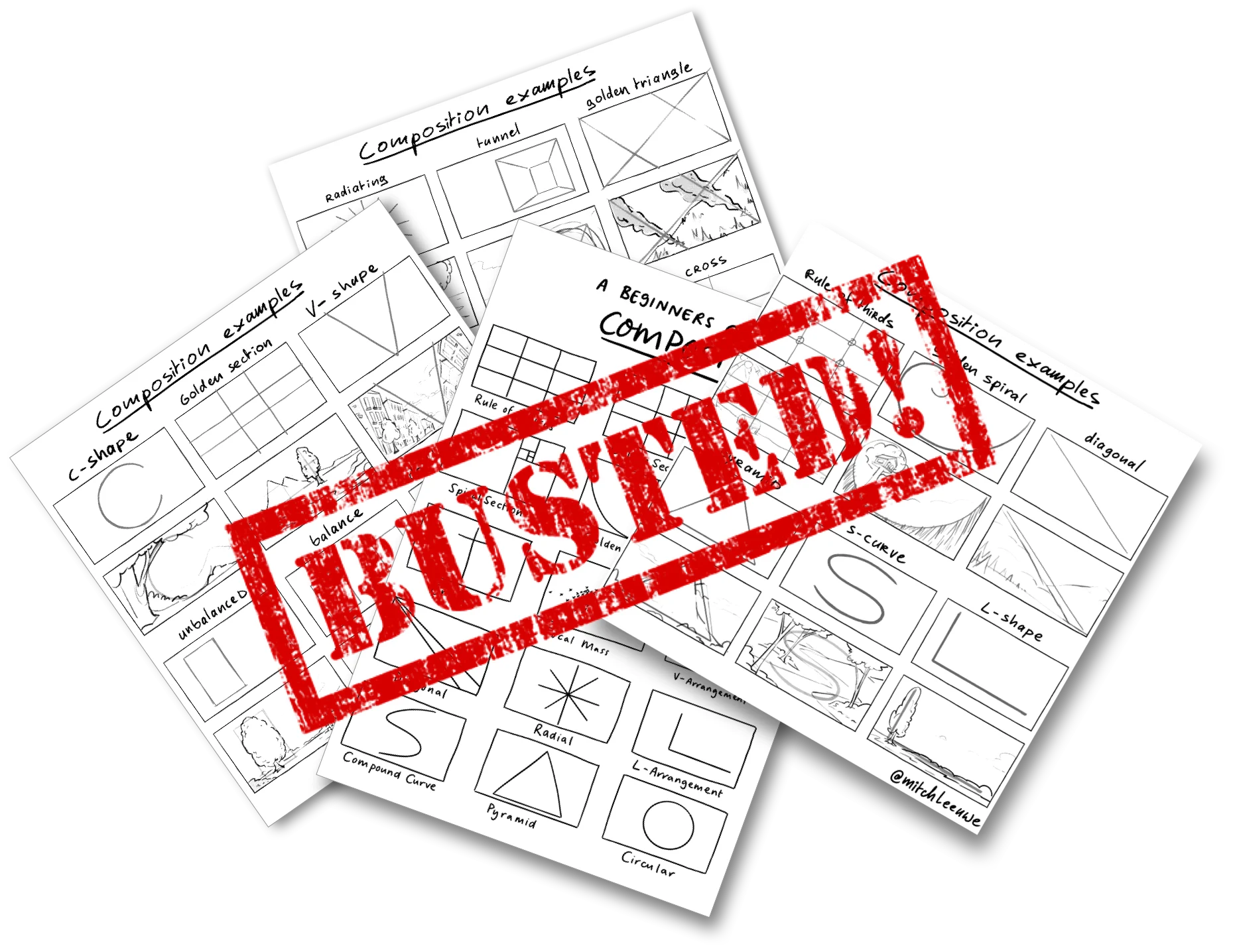
The Rule of Thirds is the simplest version of what Pacioli was getting at. The Phi Grid is the closer, more accurate cousin, derived directly from the Golden Ratio that Leonardo illustrated. The Fibonacci Spiral is the visual form of the number sequence that gives the Golden Ratio its math. The Golden Triangle applies the ratio to diagonals. Symmetry, Vanishing Point, Framing Depth, Landscape Depth, Leading Lines, Lines and Patterns, Fill the Frame, Negative Space, Left to Right, Dynamic Symmetry, and Harmonic Armature complete the set.
If you have ever wondered why some photographs stop you cold while others slide past your eye unnoticed, the answer is almost always one of these fifteen. They were not invented in a meeting. They were discovered in caves, refined in temples, formalized in the Renaissance, and weaponized for the camera by a man who learned them from a man who learned them from books that quoted a friar who hired Leonardo to draw his solids.
That is the conspiracy. Five hundred years of artists quietly passing the same set of tools to each other, generation after generation, while the rest of us walked past their paintings muttering, "hmm, nice."
You Are Now Inside the Conspiracy
Becoming a member of the Artistic Composition website is essentially an initiation into this 500-year-old secret club, except instead of a robe, we send you a poster.
The Full Access lifetime membership unlocks all fifteen artistic compositions in depth — explainer videos, real-world examples, application steps, storytelling guidance, and expert advice. One payment. No subscriptions. No free trial that quietly bills you in thirty days. We think Pacioli would have approved; he was, after all, also a Franciscan friar, and they were not famous for nickel-and-diming people. You also get the free Artistic Compositions Poster, perfect for studios, classrooms, and the wall behind your desk where you keep meaning to learn this stuff.
For shooting in real time, the Wise Camera app overlays each of the fifteen grids onto your iPhone screen as you frame a shot — Phi Grid for landscapes, Fibonacci Spiral for nature, Golden Triangle for diagonals, all of them, switchable with a tap. For rescuing photos you have already taken, the Wise Photos app lets you crop and recompose existing shots to any of the rules; that sunset you almost ruined last summer is probably one Phi Grid crop away from being your screensaver.
Cartier-Bresson would probably have grumbled at both apps. Then he would have died at 95 with a small smile, knowing that 1.618 had survived him just fine.
References
- Cartier-Bresson, Henri. The Mind's Eye: Writings on Photography and Photographers. Aperture, 1999.
- Ghyka, Matila. The Geometry of Art and Life. Dover Publications, 1977.
- Hambidge, Jay. The Elements of Dynamic Symmetry. Dover Publications, 1967 (originally 1919).
- Livio, Mario. The Golden Ratio: The Story of Phi, the World's Most Astonishing Number. Broadway Books, 2002.
- Meisner, Gary B. The Golden Ratio: The Divine Beauty of Mathematics. Race Point Publishing, 2018.
- Meisner, Gary B. "Leonardo da Vinci and the Golden Ratio in Art." GoldenNumber.net.
- Meisner, Gary B. "Botticelli's Birth of Venus and the Golden Ratio." GoldenNumber.net.
- Pacioli, Luca. De Divina Proportione. Venice, 1509. Illustrations by Leonardo da Vinci.
- Vasari, Giorgio. Lives of the Most Eminent Painters, Sculptors, and Architects. 1550.
- Galassi, Peter. Henri Cartier-Bresson: The Modern Century. Museum of Modern Art, 2010.
Full Access
Unlock All 15 Artistic Compositions
Full Access includes all 15 artistic compositions, with in-depth information, explainer videos, example gallery, guidance, storytelling, articles, and much more.
- Lifetime access
- No subscriptions
- No need to cancel
- Free Artistic Composition Poster