Harmonic Armature
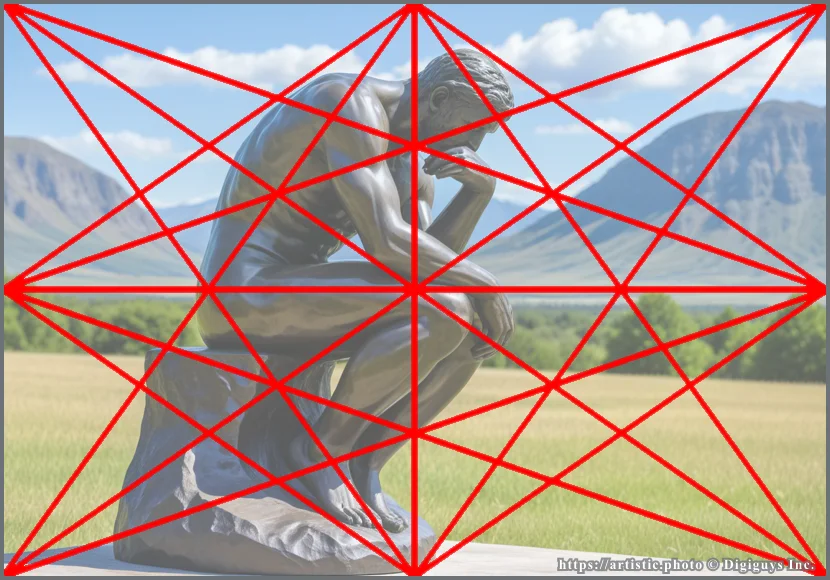
The Harmonic Armature is a compositional framework that uses a grid of intersecting lines to create balance, rhythm, and harmony in an image. At its core, it features vertical, horizontal, and diagonal lines that divide the frame into proportional sections, guiding the placement of subjects and supporting elements. The main subject is typically aligned along a diagonal or at an intersection where lines meet, naturally drawing the viewer’s eye while maintaining balance. Supporting elements are positioned along the remaining lines to create flow and cohesion, emphasizing the relationships between objects and enhancing the overall structure of the composition. This technique ensures the scene feels intentional, visually pleasing, and intuitively engaging.
Frequently Asked Questions
- What is the Harmonic Armature in composition?
- The Harmonic Armature is a grid-based compositional framework that uses intersecting vertical, horizontal, and diagonal lines to divide the frame into proportional sections. Placing the main subject along a diagonal line or at a key intersection — and positioning supporting elements along the remaining lines — creates compositions that feel both balanced and intuitively engaging.
- How is Harmonic Armature different from Dynamic Symmetry?
- Both use grids with diagonal lines, but they serve different purposes. Dynamic Symmetry prioritizes motion, energy, and dramatic tension — ideal for action-packed or street scenes. The Harmonic Armature prioritizes proportional balance and harmonic rhythm — better suited to still life, portraits, and architecture where the goal is order and beauty rather than energy.
- What does the diamond shape in the Harmonic Armature do?
- The intersection of diagonal lines in the Harmonic Armature grid creates a diamond-shaped central region that naturally concentrates visual weight. Placing your most important narrative elements within or near this diamond creates a cohesive storytelling core — the composition feels inherently organized and everything within it reads as intentional and connected.
- What types of photography benefit most from Harmonic Armature?
- Still life photography, portrait photography, architectural photography, and layered landscape compositions are where Harmonic Armature shines. Any scene where multiple elements need to feel connected and proportionally balanced — rather than simply dynamic — benefits from this framework. It is the composition of choice when you want the result to feel mathematically harmonious and timeless.